
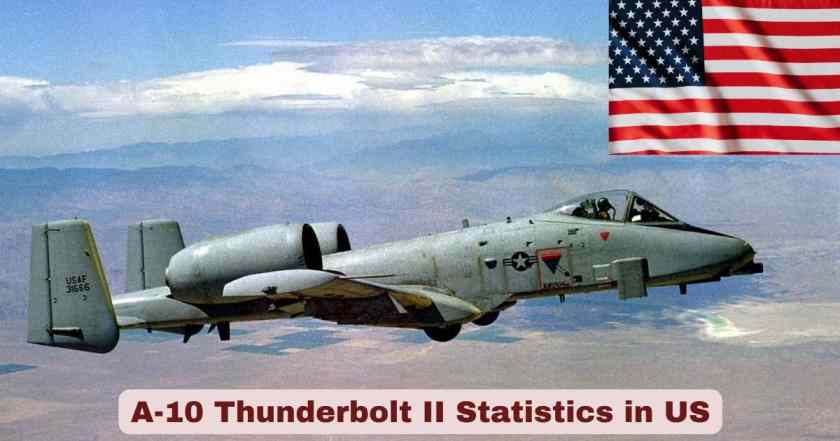
What is A-10 Thunderbolt II?
The A-10 Thunderbolt II — more widely known by its unshakeable nickname, the “Warthog” — is a single-seat, twin-turbofan, straight-wing subsonic attack aircraft built by Fairchild Republic and operated exclusively by the United States Air Force (USAF). It holds the rare distinction of being the only production aircraft ever designed from the ground up solely for the close air support (CAS) mission — flying low, slow, and directly over friendly ground troops to destroy enemy armor, vehicles, artillery, and personnel in real time. The airframe was literally built around its primary weapon: the 30 mm GAU-8/A Avenger rotary cannon, one of the most powerful guns ever mounted on a production aircraft, which accounts for roughly 16% of the A-10’s unladen weight and demanded the aircraft’s nose gear be offset to allow the firing barrel to sit on the aircraft’s centerline. First delivered to Davis-Monthan Air Force Base, Arizona, in October 1975, the A-10A entered initial operational capability in 1977, and its upgraded A-10C variant — featuring color cockpit displays, GPS-guided weapons, targeting pods, and Link 16 datalink — achieved IOC in September 2007. A total of 716 airframes were built between 1972 and 1984, making it one of the last dedicated subsonic attack aircraft ever produced for the USAF.
As of March 2026, the A-10 Thunderbolt II finds itself at one of the most contentious crossroads in its 49-year service history. The Air Force requested to retire every last one of its remaining 162 A-10s in a single fiscal year — FY2026 — a breathtaking acceleration of the previous retirement timeline that would have ended service by 2028. Congress said no. The FY2026 National Defense Authorization Act (NDAA), signed into law, flatly prohibits the Air Force from reducing its A-10 inventory below 103 aircraft through September 30, 2026, and mandates that at least 93 aircraft remain designated as primary mission aircraft. Simultaneously, the Warthog flew in active combat operations as recently as March 1, 2026, when US Central Command confirmed A-10s were employed during the first 24 hours of Operation Epic Fury. It is an aircraft that keeps fighting its retirement almost as stubbornly as it fights on the battlefield — and this article compiles every verified 2026 statistic, specification, and fact that defines the A-10 Thunderbolt II today.
Interesting A-10 Thunderbolt II Facts in the US 2026 | Key A-10 Warthog Highlights
| Fact Category | Detail |
|---|---|
| Official Designation | A-10C Thunderbolt II (current active variant) |
| Nickname | “Warthog” or simply “Hog” |
| Mission | Close Air Support (CAS), Forward Air Control (FAC-A) |
| Manufacturer | Fairchild Republic (original); Boeing/Korean Aerospace Industries (re-wing) |
| First Flight (A-10A) | May 10, 1972 |
| First Delivery to USAF | October 1975 (Davis-Monthan AFB, Arizona) |
| Initial Operational Capability (A-10A) | 1977 |
| Initial Operational Capability (A-10C) | September 2007 |
| Total Aircraft Built | 716 (production run: 1972–1984) |
| Current Total Inventory (FY2026) | ~162 aircraft |
| Primary Mission Aircraft (PMAI) Minimum — FY2026 | 93 aircraft (mandated by FY2026 NDAA) |
| Total Inventory Minimum — FY2026 | 103 aircraft (mandated by FY2026 NDAA) |
| Aircraft in Active-Duty Units (2025–2026) | Approximately 141 aircraft |
| Aircraft Stored at Boneyard (AMARG) — as of March 2025 | 95+ aircraft (A-10A and A-10C models combined) |
| A-10s Retired to Boneyard in 2024 | At least 39 aircraft |
| A-10s Authorized for Retirement in FY2025 | 56 aircraft |
| Wingspan | 57 feet 6 inches (17.5 m) |
| Length | 53 feet 4 inches (16.3 m) |
| Height | 14 feet 8 inches (4.5 m) |
| Empty Weight | 29,000 lbs (13,154 kg) |
| Maximum Takeoff Weight | 51,000 lbs (23,133 kg) |
| Top Speed | 518 mph (Mach 0.75) |
| Service Ceiling | 45,000 feet |
| Combat Range | ~800 miles (without aerial refueling) |
| Ferry Range | 2,580 miles |
| Loiter Time | Up to 90 minutes over target area |
| Primary Weapon | GAU-8/A Avenger — 30 mm, 7-barrel Gatling cannon |
| GAU-8 Rate of Fire | 3,900 rounds per minute |
| GAU-8 Ammunition Capacity | 1,174 rounds (drum holds up to 1,350) |
| GAU-8 Muzzle Velocity | ~1,070 m/s (Mach 3.1) |
| GAU-8 Recoil Force | 10,000 lbs-force (exceeds each engine’s thrust of 9,065 lbs) |
| Ordnance Payload | 16,000 lbs on 11 hardpoints (8 under-wing, 3 under-fuselage) |
| Titanium Armor (“Bathtub”) | 1,200 lbs — protects pilot from up to 23 mm rounds |
| Engines | Two General Electric TF34-GE-100 turbofans |
| Engine Thrust (each) | 9,065 lbs |
| Unit Cost (original flyaway) | $18.8 million (1970s dollars) |
| Operating Cost per Hour | Approximately $6,000/hour (one of the lowest in USAF tactical fleet) |
| Most Recent Combat Deployment | Operation Epic Fury — March 1, 2026 (US Central Command confirmed) |
| Most Recent Pre-2026 Deployment | March 29, 2025 — 124th Fighter Wing A-10s deployed to Middle East, Houthi operations |
| Confirmed Air-to-Air Kills | 2 Iraqi helicopters (Desert Storm, 1991) + drone kills in 2025 |
| Planned Full Retirement | Air Force sought FY2026; Congress blocked — new timeline: 2027–2029 |
Source: US Air Force Fact Sheet — A-10C Thunderbolt II; Air and Space Forces Magazine 2025 USAF Almanac; FY2026 National Defense Authorization Act (signed December 2025); US Central Command Public Affairs — Operation Epic Fury, March 2026; Wikipedia — Fairchild Republic A-10 Thunderbolt II (verified against USAF records)
The facts above capture something that few aircraft in history can claim: a platform that is simultaneously being retired and actively flying combat missions in the same fiscal year. The A-10’s operating cost of approximately $6,000 per flight hour makes it the cheapest tactical jet in the USAF’s entire portfolio — a number that has frustrated Air Force planners who argue the savings from retirement should be redirected to F-35 procurement, but has fueled congressional resistance from lawmakers who see no affordable, proven replacement for dedicated close air support. The GAU-8 Avenger’s recoil force of 10,000 pounds — slightly exceeding the combined thrust of each individual TF34 engine — is the kind of engineering curiosity that only the Warthog could produce: a weapon so powerful that firing it in a dive technically decelerates the aircraft.
The 2026 combat deployment confirmation from US Central Command is perhaps the most telling data point of all. While the Air Force’s FY2026 budget request sought to retire every remaining Warthog in a single year — a move that would have dismantled dedicated CAS capability overnight — the aircraft was simultaneously being called upon to fly in the opening hours of a new combat operation on March 1, 2026. The FY2026 NDAA’s mandate holding a minimum of 103 total aircraft and 93 primary mission aircraft through September 30, 2026, combined with the requirement for a full briefing on the 2027–2029 transition plan by March 31, 2026, reflects just how unsettled the Warthog’s future remains even as it keeps proving its battlefield value.
A-10 Thunderbolt II Fleet Size & Inventory Statistics in the US 2026
| Fleet Category | Data |
|---|---|
| Total A-10 Inventory (FY2026, all components) | ~162 aircraft |
| Active-Duty Aircraft (approximate) | ~141 aircraft |
| Air National Guard Aircraft | Included in total inventory |
| Air Force Reserve Command Aircraft | Included in total inventory |
| Aircraft in AMARG Storage (Boneyard) — March 2025 | 95+ aircraft (A-10A and A-10C) |
| A-10As in Boneyard Storage | Approximately 50 |
| A-10Cs in Boneyard Storage | Approximately 107 |
| Total Retired to Boneyard (Historical — all years) | 350+ |
| FY2026 NDAA Minimum Total Inventory | 103 aircraft (through Sept. 30, 2026) |
| FY2026 NDAA Primary Mission Aircraft Minimum (PMAI) | 93 aircraft (through Sept. 30, 2026) |
| A-10s Retired — FY2023 | 21 (from 122nd Fighter Wing, Fort Wayne, Indiana ANG) |
| A-10s Retired — FY2024 | At least 42 aircraft (including 39+ to boneyard by Dec. 2024) |
| A-10s Authorized for Retirement — FY2025 | 56 aircraft (~20% of then-remaining inventory) |
| Air Force’s FY2026 Budget Request | Retire all 162 remaining A-10s in a single fiscal year |
| Congressional Response (FY2026 NDAA) | Blocked — prohibited full retirement |
| Planned Transition Year | 2027–2029 (Air Force must brief Congress by March 31, 2026) |
| Replacement Aircraft | F-35A Lightning II (primary) + F-16 (interim) |
| Osan AB, South Korea (25th Fighter Sq.) | Phased out 24 A-10s — January 2025; replaced by F-16s |
| 355th Wing, Davis-Monthan AFB | Divestment began February 2024; unit transitioning |
| Indiana ANG 122nd Fighter Wing | Transitioned — 21 A-10s retired FY2023, replaced by F-16s |
| Maryland ANG 175th Fighter Wing | Transitioned — moved to cyber operations |
| Idaho ANG 124th Fighter Wing | Announced transition; early 2027 |
Source: Air and Space Forces Magazine — A-10 Fact Sheet (October 2025); Military — A-10 Boneyard Report, January 2025; FY2026 National Defense Authorization Act (December 2025); US Air Force — Davis-Monthan Public Affairs; Aerospace Global News — NDAA 2026 Analysis
The A-10 fleet’s collapse from 716 built aircraft to roughly 162 total remaining is one of the sharpest drawdowns of any combat aircraft in modern USAF history, and the pace is accelerating. The retirement of 21 aircraft in FY2023, followed by at least 42 in FY2024 and 56 authorized in FY2025, represents an annualized retirement rate that has nearly tripled in three years. The exit of the 25th Fighter Squadron from Osan Air Base, South Korea, in January 2025 — the last overseas-based A-10 unit — was a symbolic moment: for the first time since the aircraft entered service, the Warthog no longer maintains a permanent forward-deployed presence outside US borders. The Pacific Air Forces (PACAF) confirmed the South Korean A-10s were replaced by upgraded F-16 Fighting Falcons, with F-35s and F-15EX Eagle IIs supplementing coverage in the Korean theater.
Yet even as unit after unit stands down, the FY2026 NDAA draws a hard line. Congress’ mandate requiring 93 primary mission aircraft through the end of FY2026 is not a token measure — it preserves several fully staffed, fully funded CAS squadrons in operational service and explicitly prohibits the Air Force from pre-positioning aircraft for retirement through administrative actions like transferring jets to XJ status (the Air Force designation for aircraft awaiting retirement or disposition). Lawmakers cited persistent concerns that neither the F-35A nor any unmanned platform has demonstrated the A-10’s combination of loiter time, payload, low-altitude survivability, and battle damage tolerance in a high-tempo, contested close air support environment — making Congress’ intervention as much about capability gaps as it is about the aircraft itself.
A-10 Thunderbolt II Technical Specifications & Performance Statistics in the US 2026
| Specification | Value |
|---|---|
| Designation | A-10C Thunderbolt II |
| Role | Close Air Support, Forward Air Control (Airborne) |
| Crew | 1 pilot |
| Wingspan | 57 ft 6 in (17.53 m) |
| Length | 53 ft 4 in (16.26 m) |
| Height | 14 ft 8 in (4.47 m) |
| Empty Weight | 29,000 lbs (13,154 kg) |
| Gross Weight (CAS mission) | 47,094 lbs (21,361 kg) |
| Anti-Armor Mission Weight | 42,071 lbs (19,083 kg) |
| Maximum Takeoff Weight | 51,000 lbs (23,133 kg) |
| Fuel Capacity | 11,000 lbs (~1,650 US gallons) |
| Maximum Ordnance Payload | 16,000 lbs |
| Engine (x2) | General Electric TF34-GE-100 turbofan |
| Thrust per Engine | 9,065 lbs-force (40.3 kN) |
| Maximum Speed | 518 mph (Mach 0.75 / 450 knots) |
| Ferry Range | 2,580 miles (4,150 km) |
| Combat Radius (without refueling) | ~800 miles |
| Service Ceiling | 45,000 feet (13,700 m) |
| Minimum Operating Ceiling (with NVGs and targeting pods) | 1,000 feet |
| Hardpoints | 11 total — 8 under-wing, 3 under-fuselage |
| Primary Cannon | GAU-8/A Avenger — 30 × 173 mm, 7-barrel rotary |
| GAU-8 Rate of Fire | 3,900 rounds per minute |
| GAU-8 Ammunition Drum Capacity | Up to 1,350 rounds (combat load: 1,174 rounds) |
| GAU-8 Muzzle Velocity | ~1,070 m/s |
| GAU-8 Accuracy | 80% of rounds within a 40-foot diameter at 4,000 feet in a 30-degree dive |
| GAU-8 Armor Penetration | 69 mm at 500 m; 38 mm at 1,000 m |
| GAU-8 Recoil Force | 10,000 lbs-force (45 kN) |
| GAU-8 Weight (entire assembly) | ~4,000 lbs (~16% of empty airframe weight) |
| Cockpit Armor (“Titanium Bathtub”) | 1,200 lbs — resists up to 23 mm projectiles |
| Wing Configuration | Straight wing — optimized for low-speed, low-altitude operation |
| Engine Placement | Rear fuselage (high-mounted) — reduces FOD ingestion, improves IR signature management |
| Fly-By-Wire | No — mechanical flight controls with hydraulic backup; dual redundant systems |
| Re-Winged Flight Life Extension | New wings extend service life to 10,000 flight hours (from ~8,000) |
| Cockpit Upgrade (A-10C) | Color MFDs, HMCS, HOTAS, Link 16, digital stores management, Litening/Sniper targeting pods |
Source: US Air Force Fact Sheet — A-10C Thunderbolt II; General Dynamics — GAU-8/A Technical Data; Boeing — A-10 Wing Replacement Program; Military — A-10 Thunderbolt II Specifications
The engineering philosophy behind the A-10 Thunderbolt II was radical for its era and remains unique today: every major design decision was subordinated to the requirements of the GAU-8/A Avenger cannon and the survivability of the pilot in a low-altitude, high-threat environment. The aircraft’s straight wing — unusual for a jet aircraft designed in the 1970s — was chosen specifically because it allows the A-10 to fly at the slow speeds and low altitudes where accurate cannon fire is possible, while also enabling short takeoffs and landings from unimproved airstrips near the front lines. The rear-mounted TF34 turbofans create a high engine bypass ratio that results in a quieter, lower infrared signature than conventional fighter engines, complicating targeting by heat-seeking man-portable air defense systems (MANPADS). The dual redundant hydraulic and mechanical flight controls mean the aircraft can return to base even if both hydraulic systems are shot out — a real-world survivability attribute demonstrated repeatedly in combat.
The A-10C upgrade, completing the full fleet transition from 2005 through 2012, transformed what was essentially an analog attack jet into a genuinely modern combat platform. The addition of color multifunction displays (MFDs), a Helmet Mounted Cueing System (HMCS), and integration of the Litening and Sniper targeting pods gave the A-10C the ability to conduct night operations under ceilings as low as 1,000 feet — a capability once considered impossible for the platform. The Link 16 datalink and digital stores management system allow the A-10C to receive real-time targeting data, coordinate with other platforms, and deploy precision-guided munitions including JDAM, Small Diameter Bomb I (SDB I), and laser-guided bombs — weapon types that were impossible on the original A-10A. The Boeing re-wing program, delivering new assemblies extending airframe life to 10,000 flight hours, is the primary reason any A-10 can still be considered for service through 2028 or beyond.
A-10 Thunderbolt II Combat Record Statistics in the US 2026 – A-10 Warthog Battle History
| Operation / Period | Data |
|---|---|
| Combat Debut | Operation Desert Storm, January 1991 |
| Aircraft Deployed — Desert Storm | 132 A-10As (from 144 deployed to Saudi Arabia) |
| Combat Sorties — Desert Storm | 8,100 sorties in 40 days |
| Mission Capable Rate — Desert Storm | 95.7% |
| Tanks Destroyed — Desert Storm | 987 tanks |
| Combat Vehicles Destroyed — Desert Storm | 1,355 combat vehicles; 2,000+ military vehicles total |
| Artillery Pieces Destroyed — Desert Storm | 926 artillery pieces |
| Scud Missiles Destroyed — Desert Storm | 53 |
| Aircraft Shot Down — Desert Storm | 6 A-10s (of 7 total all-time combat losses) |
| Pilots Killed — Desert Storm | 2 |
| AGM-65 Maverick Usage — Desert Storm | Fired 90% of all Mavericks launched in the war |
| First Air-to-Air Kills | 2 Iraqi helicopters (GAU-8 cannon, February 1991) |
| Record Single-Day Tank Kill | 23 tanks — Capt. Eric Solomonson & Lt. John Marks, Feb. 25, 1991 |
| Bosnian War (1994–1995) | Fired approximately 10,000 rounds of 30 mm ammunition |
| Operation Iraqi Freedom (2003–2011) | 60 OA-10/A-10s deployed; mission capable rate 85%; fired 311,597 rounds of 30 mm |
| A-10 Share of All Combat Sorties — Iraqi Freedom | 32% of all combat sorties |
| Operation Enduring Freedom (Afghanistan) | Flew 11,189+ sorties in first half of 2013 alone |
| Operation Inherent Resolve (ISIS, 2014–2017) | 12 Warthogs from 74th EFS targeted 44% of ISIS targets; supported elimination of ISIS from 99% of Iraq/Syria |
| Drone Kill Markings Confirmed | October 2025 — A-10 “Ares” confirmed 2 Shahed-style drone kills using APKWS II rockets |
| Operation Epic Fury (2026) | A-10s confirmed deployed during first 24 hours — March 1, 2026 (US Central Command) |
| Total All-Time Combat Losses | 7 aircraft (6 in Desert Storm; 1 over Baghdad, April 8, 2003) |
| Total All-Time Aircraft Losses (combat + non-combat) | Multiple airframes; all 7 combat losses are confirmed total write-offs |
Source: Air and Space Forces Magazine — “To War in a Warthog” (verified historical record); Wikipedia — Fairchild Republic A-10 Thunderbolt II combat history; US Central Command Public Affairs — Operation Epic Fury, March 2026; Aerospace Global News — A-10 Warthog Retirement Update, December 2025
The A-10’s combat record is statistically one of the most effective in US Air Force history for a ground attack platform. During Operation Desert Storm in 1991 — the aircraft’s very first combat deployment — the Warthog flew 8,100 sorties in just 40 days while maintaining a 95.7% mission capable rate, numbers that would be extraordinary for a modern aircraft and are almost implausible for a design rooted in the early 1970s. The destruction of 987 tanks, 1,355 combat vehicles, 926 artillery pieces, and 53 Scud missiles in a single 40-day campaign validated the A-10’s entire design philosophy: low, slow, and precise beats high and fast when the mission is killing armor. The loss of only 6 aircraft from 8,100 sorties — a loss rate of just 0.074% — reinforced the survivability logic of the titanium cockpit, redundant controls, and damage-tolerant airframe design.
The 2025 drone kill confirmations represent something genuinely new in the A-10’s combat history. An A-10 from an Operation Inherent Resolve deployment, photographed in October 2025 with two Shahed-style drone kill markings, confirmed that the Warthog had been modified with the Advanced Precision Kill Weapons System II (APKWS II) — a laser-guided 2.75-inch rocket that can economically engage mass drone swarms at a fraction of the cost of air-to-air missiles. This development underscores why Congress remains reluctant to retire the A-10: the aircraft is not only surviving in its legacy anti-armor role but is actively adapting to one of the most pressing new threats in modern warfare. The March 1, 2026 confirmation by US Central Command that A-10s were employed in the opening hours of Operation Epic Fury means the Warthog entered 2026 not as a museum piece but as an active, combat-deployed asset.
A-10 Thunderbolt II Retirement & Replacement Statistics in the US 2026
| Retirement / Replacement Category | Data |
|---|---|
| Total A-10s Built | 716 |
| A-10 Inventory at Peak (early 2000s) | ~356 aircraft |
| A-10 Inventory at Start of FY2023 | 281 aircraft |
| A-10 Inventory at Start of FY2024 | 260 aircraft |
| A-10 Inventory at Start of FY2025 | ~218 aircraft |
| A-10 Inventory as of FY2026 | ~162 aircraft |
| Aircraft Retired FY2023 | 21 |
| Aircraft Retired FY2024 | 42 |
| Aircraft Authorized for Retirement FY2025 | 56 |
| Air Force FY2026 Budget Request | Retire all 162 remaining in FY2026 |
| FY2026 NDAA Floor (Total Inventory) | 103 aircraft (through September 30, 2026) |
| FY2026 NDAA Floor (Primary Mission Aircraft) | 93 aircraft (through September 30, 2026) |
| Congress Deadline for Transition Briefing | March 31, 2026 — Air Force must brief 2027–2029 plan |
| A-10s in AMARG Storage (as of March 2025) | 95+ aircraft |
| Expected Full Retirement Year (Congressional Timeline) | 2027–2029 |
| Primary Replacement Aircraft | F-35A Lightning II |
| Interim Replacement (ANG/Reserve Units) | F-16C/D Fighting Falcon |
| Units Transitioned Already | Indiana ANG (F-16); Maryland ANG (Cyber); Osan AB, South Korea (F-16) |
| Re-Wing Program (ATTACK) Contract Value | $999 million (Boeing, awarded August 2019) |
| Re-Wing Program Wing Sets Contracted | Up to 112 wing assemblies + 15 spare kits |
| Previous Re-Wing Program (2007–2017) | 173 wing sets delivered under $1.1 billion Enhanced Wing Assembly contract |
| Flight Life After New Wings | 10,000 hours (extended from ~8,000) |
| Boeing’s Declared Maximum Service Life with TUSK Wings | 2040 (February 2016 Boeing statement) |
| Minimum Inventory Required by Previous Law (2016 NDAA) | 171 primary mission aircraft |
| NDAA 2025 Minimum Inventory | Reduced from 135 to 96 aircraft |
| NDAA 2026 Minimum PMAI | Further adjusted to 93 aircraft |
Source: FY2026 National Defense Authorization Act (signed December 2025); Air and Space Forces Magazine — A-10 Fact Sheet; Military — A-10 Boneyard Report, January 2025; Boeing — A-10 Wing Replacement Program; The Aviationist — FY2026 NDAA Review, December 2025
The trajectory of the A-10 fleet from 356 aircraft in the early 2000s to ~162 today is a study in the tension between operational utility and modernization economics. The Air Force has sought to retire the Warthog in every budget cycle since 2012, citing the cost of maintaining a specialized single-mission platform when multi-role jets like the F-35A can theoretically cover the same territory. Congress has blocked, delayed, or constrained every single retirement attempt — a streak of legislative intervention now spanning more than a decade. What changed in FY2023 was not the Air Force’s argument but Congress’s patience: the first A-10 retirements in the 21st century were finally approved, opening the floodgates to an accelerating divestment that saw 42 retirements in FY2024 and 56 authorized in FY2025. The Air Force’s FY2026 request to retire all 162 remaining aircraft in a single year was an enormous leap — a request that Congress rejected emphatically by setting a 103-aircraft floor and demanding a phased transition plan.
The Boeing re-wing program adds its own layer of complexity to the retirement debate. Under the $999 million ATTACK contract awarded in August 2019, Boeing and Korean Aerospace Industries are delivering wing assemblies that extend A-10 airframe life to 10,000 flight hours — enough to keep the aircraft technically flyable potentially through 2035–2040. The fact that 173 wing sets were delivered under the prior contract and up to 112 more were contracted in 2019 means the Air Force has been funding long-term airframe life extensions for aircraft it simultaneously wants to retire — a procurement contradiction driven entirely by congressional mandates. With the Air Force now required to brief Congress by March 31, 2026 on a unit-by-unit 2027–2029 divestment plan, the next 12 months will likely determine whether the Warthog exits service in an orderly, planned transition or continues to be preserved by a Congress that simply does not yet trust the replacement strategy.
A-10 Thunderbolt II Budget & Operating Cost Statistics in the US 2026
| Cost Category | Data |
|---|---|
| Original Unit Flyaway Cost | $18.8 million (1970s production dollars) |
| Total Program Cost per Aircraft (1994 dollars) | ~$13 million (including development amortization) |
| Operating Cost per Flight Hour | Approximately $6,000 |
| Comparative F-35A Operating Cost per Hour | ~$35,000+ (FY2024 estimate) |
| Comparative F-16 Operating Cost per Hour | ~$22,000 |
| A-10’s Cost Advantage vs F-35A (per flight hour) | Approximately 5.8× cheaper |
| A-10 Wing Replacement Contract (2019, Boeing) | $999 million (IDIQ ceiling for up to 112 wing sets + 15 kits) |
| Initial Contract Obligation (27 wing sets) | $240 million |
| Prior Re-Wing Contract (2007–2017) | $1.1 billion (173 Enhanced Wing Assemblies) |
| Total Re-Wing Investment (both programs) | ~$2.1 billion+ |
| SLEP Options Evaluated (2005) | Options ranged from $1.72 billion to $4.6 billion |
| GAO Cost Estimate (2007) — Full Upgrade/SLEP | $2.25 billion through 2013 |
| FY2026 USAF Request to Retire A-10 (savings rationale) | Redirect funding to F-35A procurement and personnel |
| Congressional Resistance Basis | No funded, proven CAS replacement; F-35A operating cost ~5× higher |
| FY2026 Budget: A-10 Sustainment Status | Active sustainment — Congress blocked divestment |
| Minimum Inventory Maintained (NDAA 2026) | 103 total / 93 PMAI through September 30, 2026 |
Source: US Air Force Fact Sheet — A-10C Thunderbolt II; Military Machine — A-10 Warthog Cost Analysis; Boeing — A-10 Wing Replacement Program; GAO — Aircraft Operating Costs Report; The Drive — War Zone, A-10 Re-Wing Program, 2022
The A-10’s operating cost of approximately $6,000 per flight hour is the single most powerful argument for its continued use and the most repeated figure in every congressional battle over its retirement. In a tactical jet fleet where the F-35A costs approximately $35,000 per flight hour and the F-16 runs around $22,000, the Warthog is not just cheaper — it is in a completely different cost category. For the persistent, permissive-environment close air support missions that have defined American counterterrorism and counterinsurgency operations for 25 years, flying an F-35A instead of an A-10 is mathematically equivalent to using a $35 million race car to deliver a $6 pizza. This cost differential is precisely why Congress has repeatedly funded the re-wing program instead of accepting retirement: with over $2.1 billion invested in airframe life extensions across two major contracts, the infrastructure for operating the A-10 through the late 2030s already exists and has been paid for.
The Air Force’s counter-argument — that savings from retiring the A-10 should fund F-35A procurement — has technical merit in a high-end, contested environment where the A-10’s subsonic speed and large radar cross-section would make it vulnerable. But the FY2026 NDAA made clear that Congress is not satisfied with the Air Force’s transition roadmap, demanding a detailed 2027–2029 unit-by-unit plan by March 31, 2026 that covers mission reassignment, personnel impacts, and follow-on aircraft assignments for each affected wing. Until that plan is delivered and approved, the Warthog’s sustainment budget remains protected, its squadrons remain funded, and its pilots keep flying — a fiscal reality that has kept the world’s most cost-effective tactical jet airborne for nearly 50 consecutive years.
A-10 Thunderbolt II Armament & Weapons Load Statistics in the US 2026
| Armament / Weapons Category | Data |
|---|---|
| Primary Fixed Weapon | GAU-8/A Avenger — 30 mm, 7-barrel rotary autocannon |
| GAU-8 Cannon Weight (full assembly) | ~4,000 lbs (entire A/A 49E-6 Gun System) |
| GAU-8 Cannon Rate of Fire | 3,900 rounds per minute (fixed rate; originally selectable at 2,100 or 4,200) |
| GAU-8 Ammunition Types | API-T (Armor Piercing Incendiary — Tracer), HEI (High Explosive Incendiary), HEI/API-T mix |
| Standard Combat Load (Rounds) | 1,174 rounds |
| GAU-8 First Burst (1 second) | ~50 rounds |
| GAU-8 Sustained Fire Rate | ~65–70 rounds per second after spin-up |
| Maximum Continuous Fire (before ammo depletion) | ~18 seconds at full rate |
| GAU-8 Accuracy | 80% of rounds within 40-foot (12.4 m) diameter at 4,000 ft in a 30° dive |
| GAU-8 Armor Penetration | 69 mm at 500 m; 38 mm at 1,000 m |
| Ammunition Cartridge Dimensions | 30 × 173 mm — 11.4 inches long, 1.53 lbs per cartridge |
| Total Hardpoints | 11 (8 under-wing, 3 under-fuselage) |
| Maximum External Ordnance | 16,000 lbs |
| Air-to-Ground Missiles | AGM-65 Maverick (TV-guided and infrared variants) |
| Air-to-Air Missiles | AIM-9 Sidewinder (self-defense) |
| Guided Bombs | Mk-82/84 series; GBU-12 Paveway II; GBU-38 JDAM; GBU-39 Small Diameter Bomb I |
| Rockets | 2.75-inch Hydra rockets; APKWS II (laser-guided — added 2025) |
| Unguided Bombs | Mk-82 500 lb; Mk-84 2,000 lb; CBU cluster bombs |
| Electronic Countermeasures | AN/ALQ-184 ECM Pod; chaff; infrared flares |
| Targeting Pod | AN/AAQ-28 Litening AT; Sniper ATP |
| Helmet Mounted Cueing System (HMCS) | Yes — A-10C upgrade |
| New Anti-Drone Weapon (2025) | APKWS II — laser-guided 2.75-inch rockets, confirmed effective against Shahed-style drones |
| Ordnance Equivalent to 4 AH-64 Apaches | A single A-10 carries the equivalent payload of 4 Apache attack helicopters |
Source: US Air Force Fact Sheet — A-10C Thunderbolt II; General Dynamics Ordnance and Tactical Systems — GAU-8/A Data Sheet; Military — A-10 Thunderbolt II Armament; Aerospace Global News — A-10 Warthog Drone Kill Confirmation, December 2025
The A-10’s weapons load is built around a layered philosophy that no other USAF aircraft currently replicates: a cannon so powerful that its recoil exceeds the output of each engine, backed by an ordnance payload so large that a single Warthog can carry the equivalent firepower of four AH-64 Apache attack helicopters. The GAU-8/A Avenger fires 30 mm depleted uranium armor-piercing rounds at 3,900 rounds per minute — a rate that allows a one-second burst to put 50 rounds on a target and a two-second burst to reliably destroy most main battle tanks from the Cold War era. What is less appreciated is the cannon’s accuracy specification: 80% of rounds landing within a 40-foot diameter at 4,000 feet range in a 30-degree dive is a performance standard that translates directly to reduced collateral damage in the close air support mission, where friendly forces may be within hundreds of meters of the target.
The addition of APKWS II guided rockets in 2025 represents the most significant weapons integration on the A-10C in recent years. The Advanced Precision Kill Weapons System II converts standard unguided 2.75-inch (70 mm) Hydra rockets into laser-guided munitions at a fraction of the cost of the AGM-65 Maverick or the AIM-120 AMRAAM — weapons costing tens or hundreds of thousands of dollars per shot. Against mass drone swarms like the Iranian Shahed series, APKWS II allows an A-10 to engage dozens of targets per mission at a cost of roughly $10,000–$15,000 per round versus $400,000+ per AIM-120 missile. The October 2025 confirmation that an A-10 carrying APKWS II had scored two confirmed drone kills in active combat operations — with the kill markings visible on the aircraft’s fuselage — validated the integration in real-world conditions and added a genuinely new dimension to the Warthog’s already formidable weapons résumé.
Disclaimer: This research report is compiled from publicly available sources. While reasonable efforts have been made to ensure accuracy, no representation or warranty, express or implied, is given as to the completeness or reliability of the information. We accept no liability for any errors, omissions, losses, or damages of any kind arising from the use of this report.